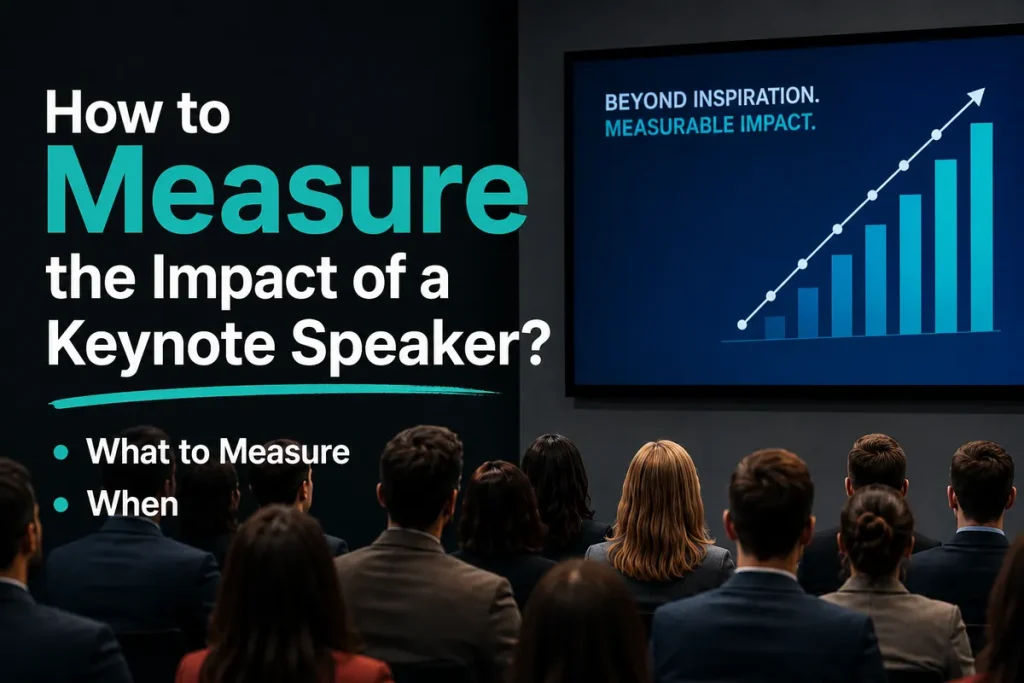
The Workforce Is Changing Faster Than Your Strategy
Most organizations are still designing teams, job descriptions, and L&D budgets for a world that no longer exists. Skills that took years to develop are losing market value inside eighteen months. The training programs built to address this? They were designed for a slower era.
Ian Beacraft has a name for what’s happening: the Skill Flux Era. And his prescription for surviving it — organizational, strategic, and human — is what makes him one of the most urgently relevant future of work speakers working today.
What the Skill Flux Era Actually Means for Organizations
Beacraft introduced his Skill Flux framework on the main stage at SXSW 2025, where he argued that the half-life of a technical skill has collapsed to roughly 2.5 years — and is continuing to shrink. The implication is significant: by the time an organization finishes a traditional reskilling program, a meaningful portion of what was taught is already declining in value.
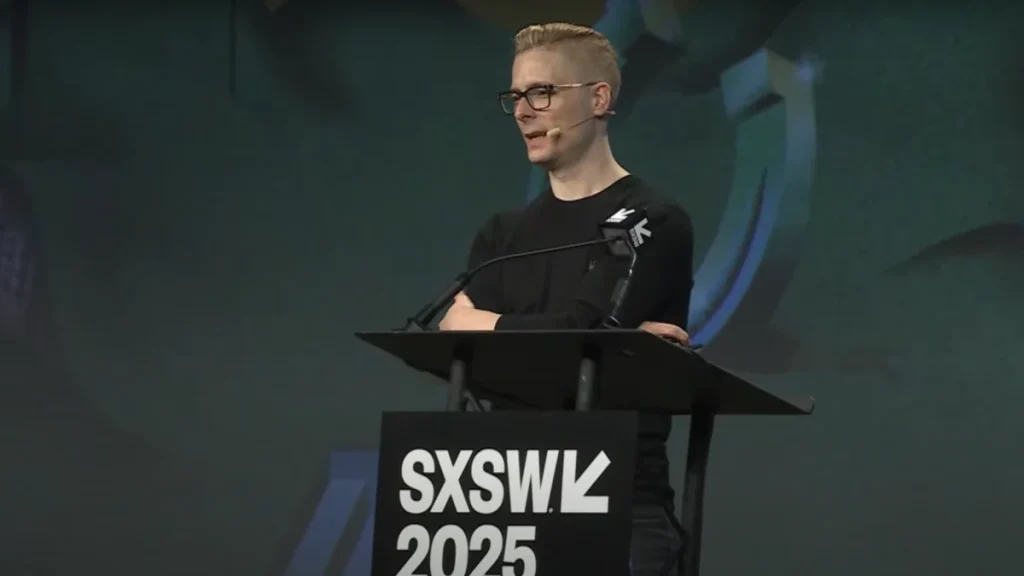
Ian Beacraft delivers a keynote on AI and the future of work at SXSW 2025.
This isn’t a technology problem. It’s a structural one. Most enterprises were built on specialization as the path to performance. Beacraft argues that AI has fundamentally inverted that logic. The new competitive unit isn’t the deep specialist — it’s what he calls the “creative generalist”: an individual with the curiosity to move across domains and the adaptability to learn at the point of need.
The response to Skill Flux, in his framework, is surge skilling — rapid, high-signal learning cycles tied directly to business priorities, rather than front-loaded education programs disconnected from day-to-day work. Learning budgets, he argues, will need to match or exceed technology budgets if organizations hope to keep pace.
Billion Dollar Teams: The Strategic Vision Behind the Framework

The Billion Dollar Team concept: how AI-augmented small teams are redefining what’s possible in the modern workplace.
The practical endpoint of Beacraft’s thinking is what he calls the Billion Dollar Team. The premise is direct: AI-augmented small teams can now generate output — in volume, variety, and speed — that previously required headcount an order of magnitude larger. But this isn’t a story about headcount reduction. It’s a story about value creation at a scale most organizations haven’t yet imagined.
In his keynote of the same name — which he delivered on SXSW’s main stage — Beacraft walks audiences through how forward-thinking organizations are redesigning team architecture, redefining metrics of success, and embedding AI not as a tool layer but as a structural collaborator. The session draws directly from his advisory work with companies including Google, Microsoft, Nike, Samsung, and Deloitte.
What separates Beacraft’s approach from the futurism-as-trend-spotting genre is that it’s operational. His firm, Signal and Cipher, builds the actual transformation frameworks, upskilling programs, and job redesign systems that organizations deploy after the keynote. The stage talk and the strategic work are the same product.
The Gonzo Futurist Advantage
Beacraft describes himself as a “Gonzo Futurist” — a term borrowed from journalism’s tradition of embedded, first-person reporting. The methodology is the differentiator: rather than analyzing emerging technologies from the sidelines, he experiments with them before they leave the research lab, then speaks from direct experience.
This approach led him to become the first person to host a globally syndicated news segment as a synthetic human — a milestone explored further in our roundup of AI keynote speakers who built the technology. His program, The Future Report on Defiance Media, reached over 100 million devices worldwide — not as a stunt, but as a proof-of-concept for how AI speakers and synthetic media can work in real broadcast contexts. Executives in his audience aren’t being told what might be possible. They’re watching it operate.
It also informs his warning about large language models: “LLMs will make you average,” he told SXSW attendees. Because these models have effectively codified the vast majority of publicly available human knowledge, organizations that use them without proprietary data or creative differentiation will converge on the same outputs as every competitor. The advantage, he argues, lies in the 1% — the high-signal, context-specific, proprietary knowledge that organizations possess but rarely mobilize.
Why Event Organizers Book Ian Beacraft
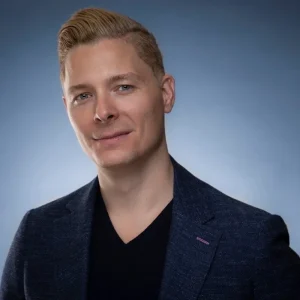
Ian Beacraft, AI and workforce transformation keynote speaker and founder of Signal and Cipher.
Audiences at Beacraft’s sessions don’t encounter abstract predictions about a distant future. They encounter a structured argument about what is already breaking in their organizations — and an operational vocabulary for addressing it. His presentations are immersive by design: he integrates live technology demonstrations and extended reality elements that make his claims tangible in the room.
He has delivered keynotes in more than 20 countries and appeared at SXSW for four consecutive years, alongside major forums including CES, Web Summit, and events hosted by Google and Microsoft — placing him consistently among the top technology keynote speakers on the global circuit. For event organizers seeking a session on AI and the workforce that leaves leaders with a framework, not just a feeling, Ian Beacraft is among the most consistently effective choices at a global scale — and one of the top 5 AI speakers we recommend for corporate events. Beacraft is also featured as one of the top futurist voices for corporate events in Aurum’s futurist keynote speakers overview, alongside speakers covering AI strategy, geopolitics, and long-horizon forecasting.
Those looking to place him alongside complementary perspectives should consider that he pairs naturally with sessions on leadership and organizational culture, particularly for multi-track events where workforce strategy and technology adoption sit on the same agenda.
FAQ
Why should organizations book Ian Beacraft as a keynote speaker?
Ian Beacraft delivers something rare on the AI keynote circuit: a session that is simultaneously strategic and operational. His frameworks — Skill Flux, surge skilling, and Billion Dollar Teams — give leadership audiences a shared vocabulary for the workforce transformation challenge, not just awareness that the challenge exists. His client roster includes Google, Nike, Microsoft, Samsung, and Deloitte, which signals the caliber of organization that has trusted his counsel. Beacraft also performs at a production level most speakers cannot match: live technology demonstrations, synthetic media integrations, and immersive delivery formats make the future feel immediate rather than theoretical. Contact Aurum Speakers Bureau to check his availability.
What is the Skill Flux framework Ian Beacraft introduced at SXSW?
Skill Flux describes the accelerating cycle in which professional competencies gain and lose commercial value. Beacraft argued at SXSW 2025 that the shelf life of a technical skill has collapsed to approximately 2.5 years and continues to shrink. The framework identifies surge skilling — rapid, demand-triggered learning cycles — as the organizational response, replacing traditional front-loaded education programs with continuous, point-of-need skill acquisition timed to business priorities.
What types of organizations and events is Ian Beacraft best suited for?
Beacraft is particularly effective at events where senior leaders need to move from general AI awareness to workforce strategy. His sessions resonate strongly with CHROs, CTOs, Chief Innovation Officers, and executive leadership teams navigating AI adoption at scale. He is regularly booked for large corporate conferences, HR summits, technology industry events, and CEO forums. He has delivered keynotes in over 20 countries and is available for both in-person and virtual formats.
What makes Ian Beacraft different from other futurist keynote speakers?
Most futurists occupy a position of informed observation — they analyze trends and communicate implications. Beacraft’s “Gonzo Futurist” methodology is explicitly participatory: he experiments with technologies before they reach mainstream adoption, which means his keynotes are grounded in direct experience rather than extrapolation. This is what led him to become the first person to host a syndicated news segment as a synthetic human, reaching over 100 million devices globally. Combined with his background running innovation and P&L departments at major advertising agencies, he brings a commercial pragmatism that purely academic or journalistic futurists rarely match.
To explore booking Ian Beacraft for your next event, reach out to Aurum Speakers Bureau. Our team will be in touch asap.