
Stew Friedman
Practice Professor of Management Emeritus, The Wharton School | Creator of Total Leadership | Authority on Work/Life Integration | Thinkers50 Distinguished Achievement Award



Jerry Yang & Akiko Yamazaki Professor, Stanford HAI | Director, Stanford Digital Economy Lab | NYT Bestselling Author | Co-Founder, Workhelix | Thinkers50
Erik Brynjolfsson is the economist who put numbers on the AI revolution before anyone else was asking the question. Director of Stanford's Digital Economy Lab, co-author of The Second Machine Age, and one of the world's most-cited researchers on technology and productivity, he gives leaders the evidence-based frameworks they need to turn AI investment into measurable results — and to understand what happens when organisations get it wrong.
Want to book Erik Brynjolfsson as a speaker for your event? Please provide the info below and we’ll get in touch within 24h:
Erik Brynjolfsson is one of the world’s foremost authorities on the economics of artificial intelligence and digital technology — a Stanford professor whose research has fundamentally shaped how business leaders, policymakers, and economists understand the relationship between technology, productivity, and human prosperity. Born in Roskilde, Denmark, he trained at Harvard in applied mathematics and decision sciences before earning his doctorate in managerial economics at MIT, where he spent three decades building the discipline now known as digital economics.
AI speaker Erik Brynjolfsson is best known for pioneering the empirical measurement of how technology drives — and sometimes disappoints — economic growth. He was among the first researchers to quantify the productivity impact of IT investment and to identify why benefits often arrive later than expected, a framework he called the productivity J-curve. With more than 152,000 academic citations, he ranks among the most influential economists alive, and the Financial Times‘ Martin Wolf has written that no economist has done more to illuminate the revolutionary implications of information technology.
His books have reached global audiences and shaped executive thinking at the highest levels. The Second Machine Age, co-authored with Andrew McAfee, became a New York Times bestseller and reframed the debate around automation, skills, and inequality. Machine, Platform, Crowd followed, offering leaders a strategic map for navigating digital disruption. His most recent work, The Economics of Transformative AI, published by the University of Chicago Press, examines how AI systems capable of rapidly reshaping entire economies should be understood, governed, and deployed.
Today, Brynjolfsson holds the Jerry Yang and Akiko Yamazaki Professorship at the Stanford Institute for Human-Centered AI (HAI) and directs the Stanford Digital Economy Lab, where he leads research on Transformative AI — systems poised to reshape productivity, labor markets, and prosperity at unprecedented scale. He also serves as Ralph Landau Senior Fellow at the Stanford Institute for Economic Policy Research, holds appointments at the Stanford Graduate School of Business and Stanford Department of Economics, and is a Research Associate at the National Bureau of Economic Research. He co-founded the AI Index in 2016 and has testified on AI before the United States Congress, participated in AI Summits at the White House, and was named to the Thinkers50 list of the world’s top management thinkers in both 2021 and 2023. He is also co-founder of Workhelix, a company that helps organizations identify where generative AI creates the most value.
As a speaker, Erik Brynjolfsson offers what few AI voices can: the rigour of a world-class research economist combined with the clarity of a communicator who has spent decades translating frontier science into actionable insight. Audiences gain a grounded, evidence-based understanding of where AI will genuinely transform industries, where the hype outpaces reality, and — most importantly — how leaders can restructure their organizations to capture the productivity gains that AI makes possible without leaving workers or societies behind.
Drawing on his ongoing research at Stanford's Digital Economy Lab, Brynjolfsson cuts through the noise to examine what the data actually shows about AI's impact on productivity, labor markets, and organisational performance. He explains why AI's greatest economic effects are still ahead — and what organisations must do now to position themselves on the right side of the productivity J-curve. Audiences leave with a rigorous, evidence-grounded understanding of the AI opportunity that goes far beyond the headlines.
Technology is advancing faster than the institutions, skills, and management practices needed to harness it. In this keynote, Brynjolfsson draws on the research behind his bestselling books to show how organisations can restructure workflows, talent strategies, and decision-making processes to capture the productivity gains that AI makes possible — while avoiding the traps that cause most companies to underperform. He offers a practical roadmap for leaders who want to move from AI experimentation to AI-driven transformation.
Platforms are reshaping industries. AI is automating tasks once thought uniquely human. And the crowd — distributed networks of people and machines — is unlocking new forms of value creation that traditional hierarchies cannot replicate. Brynjolfsson examines the strategic logic behind these three forces and helps leaders understand which parts of their business face the greatest disruption risk, where their competitive moats are deepening, and how to build organisations capable of thriving as the rules of competition continue to evolve.
Practice Professor of Management Emeritus, The Wharton School | Creator of Total Leadership | Authority on Work/Life Integration | Thinkers50 Distinguished Achievement Award
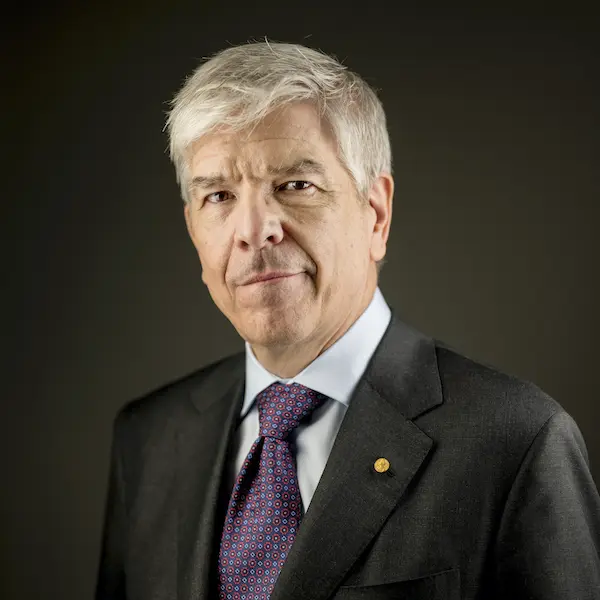
2018 Nobel Laureate in Economics | Seidner University Professor, Boston College | Pioneer of Endogenous Growth Theory | Urbanization & Innovation Expert

Youngest Nobel Peace Prize Laureate in History | UN Messenger of Peace | Co-Founder & Executive Chair, Malala Fund

3x Olympian | Cool Runnings Jamaican Bobsled Pioneer | Resilience & Teamwork Speaker


© 2026 Aurum Speakers Bureau. All Rights Reserved

| Basic Data Protection Information | |
|---|---|
| Data controller | AURUM SPEAKERS BUREAU S.L. |
| Address | Parc Audiovisual de Catalunya 1, Oficina S11, 08225 Terrassa, Spain |
| Purposes | We will use your data to respond to your requests and deliver our services to you. |
| Marketing | We will only send you marketing correspondence if you have given your prior consent, which you can do by ticking the box for that purpose. |
| Lawful basis | We will only process your data if you have given your prior consent, which you can do by ticking the box for that purpose. |
| Recipients | Generally, only our members of staff who have been duly authorised may access the data that you have provided. |
| Your Rights | You have the right to know what information we hold about you, to rectify it and to erase it, as explained in the additional information available on our website. |
| Additional Information | For more information, please see our "PRIVACY POLICY". |