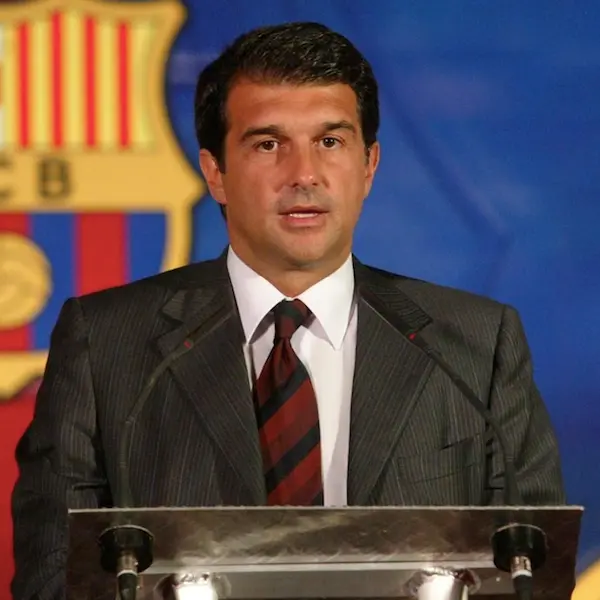
Joan Laporta
President of FC Barcelona (2003-2010 & 2021-2031) | Architect of the 2009 Sextuple & FC Barcelona's Golden Era | Lawyer | Leadership & Turnaround Speaker


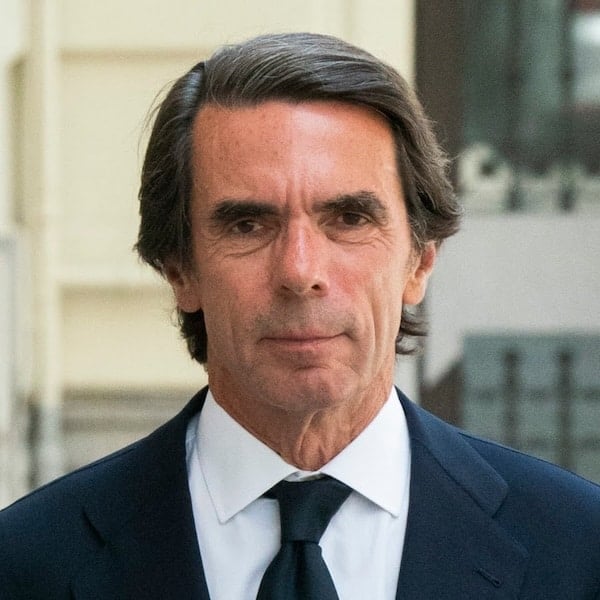
Prime Minister of Spain (1996-2004) | Executive President, FAES | Distinguished Fellow, Johns Hopkins SAIS | Honorary Chairman, Partido Popular
José María Aznar served as Prime Minister of Spain for eight years, leading his country from economic stagnation to the eighth-largest economy in the world, taking Spain into the euro, and establishing himself as one of Europe's most consequential conservative leaders. Since leaving office, he has remained a significant voice in Western geopolitics, transatlantic relations, and the defence of liberal democratic values through FAES and Johns Hopkins SAIS.
Want to book José María Aznar as a speaker for your event? Please provide the info below and we’ll get in touch within 24h:
José María Aznar is one of Europe’s most consequential conservative statesmen of the past three decades. He served as Prime Minister of Spain from 1996 to 2004 — eight years across two consecutive terms, the second won with an absolute parliamentary majority — during which he presided over one of the most significant economic transformations in Spain’s modern history. A qualified State Tax Inspector who entered politics in 1979 and rose to lead the Partido Popular (PP) in 1990, he defeated Felipe González’s Socialist government in 1996 and left office voluntarily in 2004, having kept his promise not to seek a third term.
As a political speaker, Aznar’s economic legacy is substantial. When he took office, Spain was struggling with high unemployment, a persistent deficit, and sluggish growth. His government implemented a comprehensive program of market liberalization, privatization, and fiscal consolidation that created more than five million new jobs, produced a budget surplus, increased Spain’s GNP by 68%, and propelled the country to the eighth largest economy in the world. His government took Spain into the euro in 1999 and carried out one of the most successful fiscal adjustments in European history, completing it in time for eurozone entry. He also led Spain’s integration into the highest tables of Western security and foreign policy, including active engagement in NATO operations and a close strategic partnership with the United States and the United Kingdom.
Since leaving office, Aznar has remained one of the most vocal and internationally recognized voices in the Western conservative tradition. He is the Executive President of FAES (Fundación para el Análisis y los Estudios Sociales), the leading classical-liberal think tank in Spain, which he has led since 1989 and which has become one of the most influential centers of political ideas in the Spanish-speaking world. He is a Distinguished Fellow at the Paul H. Nitze School of Advanced International Studies (SAIS) at Johns Hopkins University, where he chairs the Atlantic Basin Initiative, and a member of the International Advisory Board of the Atlantic Council of the United States. He is also a member of the Board of Directors of News Corporation and the Honorary Chairman of the Partido Popular.
Two themes have defined Aznar’s post-presidential voice more than any others: the fight against terrorism and the defence of transatlantic unity. His government survived the 1995 assassination attempt against him by ETA, the Basque separatist organization, and spent eight years implementing a firm, no-concessions counter-terrorism policy that is widely credited with weakening ETA significantly before its eventual dissolution. After the 11 September 2001 attacks, Aznar was among the earliest and most consistent European voices supporting the United States’ response, and he was a signatory to the “Letter of Eight” European leaders published in the Wall Street Journal in 2003 expressing support for the coalition in Iraq. His views on terrorism — shaped by direct personal experience and sustained engagement with counter-terrorism policy — have remained a central part of his speaking career.
As a speaker, José María Aznar delivers what few living statesmen can: firsthand perspective on governing a major European democracy through economic transformation, security crisis, and geopolitical realignment, combined with two decades of sustained engagement with the political questions that continue to define the Western order. Contact Aurum Speakers Bureau to book José María Aznar for your next event.
When Aznar took office in 1996, Spain faced high unemployment, a chronic deficit, and an economy that had fallen behind its European neighbors. Eight years later, the country had created five million jobs, run a budget surplus, increased GNP by 68%, and entered the eurozone ahead of schedule. In this keynote, Aznar examines the specific policies that drove that transformation — market liberalization, privatization, fiscal consolidation, labor market reform — and draws lessons for other European and emerging market economies navigating similar challenges today. He is direct about what worked, what he would do differently, and why the political conditions for reform are usually harder to create than the economic ones.
Aznar has more direct personal and political experience of terrorism than almost any other living European statesman. His car was targeted by an ETA car bomb in 1995. His government spent eight years confronting Basque terrorism with a no-concessions policy. He was in office on 11 March 2004 when Al-Qaeda killed 193 people in Madrid in Europe's deadliest terrorist attack since Lockerbie. In this keynote he draws on that experience to examine what effective counter-terrorism policy requires — in terms of legal frameworks, intelligence cooperation, political will, and public communication — and how the nature of the terrorist threat has evolved since the 1990s. A keynote for government, security, and policy audiences that goes well beyond the generic to the specific.
Aznar was one of the most outspoken European defenders of the transatlantic relationship during his time in office and has continued that advocacy through his post-presidential roles at Johns Hopkins SAIS, the Atlantic Council, and FAES. In this keynote he examines the current state of the transatlantic alliance — the NATO commitments, the trade disputes, the divergent approaches to China and Russia, and the domestic political pressures on both sides of the Atlantic that are straining the relationship — and makes the case for why it remains the foundational architecture of Western security and why its preservation requires active leadership rather than passive assumption. A keynote for audiences in defence, foreign policy, and international business who need a frank account of where the alliance stands.
Aznar governed Spain through an assassination attempt, an economic transformation that required unpopular reforms, the eurozone entry process, the post-9/11 security environment, and the March 2004 attacks. In this keynote he draws on those experiences to examine what leadership under pressure actually requires: the ability to maintain strategic direction when the political environment turns hostile, to communicate with conviction even when the message is unwelcome, and to make decisions whose consequences will outlast the political cycle in which they are taken. Less a policy lecture than a practitioner's account of what governing actually feels like from the inside, this keynote resonates particularly with audiences in business, government, and public institutions facing their own moments of consequential decision-making.
President of FC Barcelona (2003-2010 & 2021-2031) | Architect of the 2009 Sextuple & FC Barcelona's Golden Era | Lawyer | Leadership & Turnaround Speaker

Dieter Schwarz Associate Professor of AI & Work, Oxford | Director, Future of Work Programme | Author, How Progress Ends & The Technology Trap

LEGO® Professor of Management & Innovation at IMD | Director, Center for Future Readiness | Thinkers50 Strategy Award Winner | Bestselling Author of LEAP
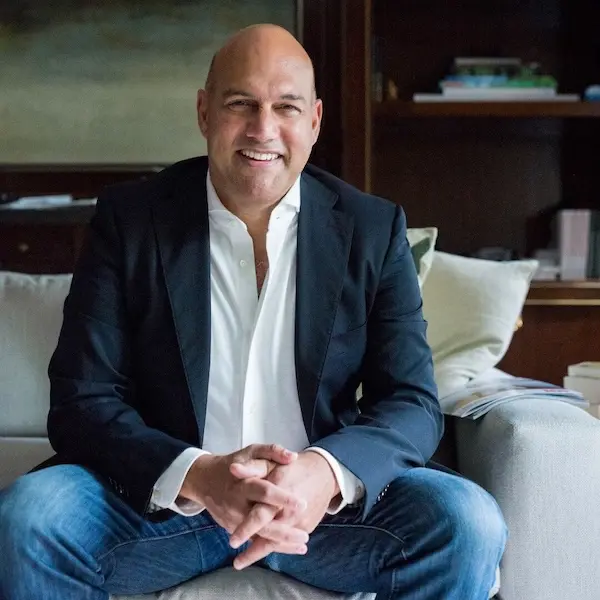
Chairman, OpenExO | Bestselling Author of Exponential Organizations & ExO 2.0 | Co-Host, Moonshots Podcast | XPRIZE Board Member | Former VP, Yahoo


© 2026 Aurum Speakers Bureau. All Rights Reserved

| Basic Data Protection Information | |
|---|---|
| Data controller | AURUM SPEAKERS BUREAU S.L. |
| Address | Parc Audiovisual de Catalunya 1, Oficina S11, 08225 Terrassa, Spain |
| Purposes | We will use your data to respond to your requests and deliver our services to you. |
| Marketing | We will only send you marketing correspondence if you have given your prior consent, which you can do by ticking the box for that purpose. |
| Lawful basis | We will only process your data if you have given your prior consent, which you can do by ticking the box for that purpose. |
| Recipients | Generally, only our members of staff who have been duly authorised may access the data that you have provided. |
| Your Rights | You have the right to know what information we hold about you, to rectify it and to erase it, as explained in the additional information available on our website. |
| Additional Information | For more information, please see our "PRIVACY POLICY". |