
Christopher Wylie
Cambridge Analytica Whistleblower | Time 100 & Forbes 30 Under 30 | Head of Insight & Emerging Technologies, H&M | PhD, University of the Arts London | Author, Mindf*ck



2020 Nobel Laureate in Economic Sciences | Adams Distinguished Professor, Stanford GSB | Pioneer of Auction Theory & Market Design
Robert Wilson's auction theory has shaped how the world allocates its most valuable resources — from oil rights to radio spectrum — earning him the 2020 Nobel Prize in Economic Sciences alongside his former student Paul Milgrom. As Adams Distinguished Professor Emeritus at Stanford GSB since 1964, he is also the mentor behind three other Nobel laureates, making him the discipline's most consequential teacher.
Want to book Robert Wilson as a speaker for your event? Please provide the info below and we’ll get in touch within 24h:
Robert B. Wilson is a 2020 Nobel Laureate in Economic Sciences and the Adams Distinguished Professor of Management, Emeritus, at the Stanford Graduate School of Business, where he has been a member of the faculty since 1964 — one of the longest academic tenures in the institution’s history. A Harvard-trained mathematician and economist, Wilson is widely regarded as the founding architect of modern auction theory and one of the most influential figures in the development of market design, game theory, and information economics over the past sixty years.
Economics speaker Robert Wilson was awarded the Nobel Prize jointly with his Stanford colleague and former student Paul Milgrom for foundational improvements to auction theory and the invention of new auction formats. The Royal Swedish Academy of Sciences recognized how their work moved auction design from an abstract academic exercise into a practical instrument for allocating the world’s most valuable resources — from oil and gas extraction rights to the radio frequency spectrum that underpins global telecommunications. A signature contribution was Wilson’s rigorous analysis of the winner’s curse: the phenomenon whereby auction winners systematically overpay because they fail to account for what their rivals’ lower bids reveal about an asset’s true value. His theoretical proof of this dynamic, developed through consulting work with the U.S. Department of the Interior and major oil companies, changed how industries bid for public resources.
The practical consequences of Wilson and Milgrom’s work are extraordinary in scale. Together, they designed the Simultaneous Multiple Round Auction (SMRA) format adopted by the U.S. Federal Communications Commission for the 1994 radio spectrum auctions — a landmark event that reshaped the global telecommunications industry. Auctions using their design have since been used worldwide to allocate licenses worth more than $100 billion. Wilson has also contributed to the design of electricity markets, advising the California Power Exchange, the California, New England, and Ontario System Operators, and energy ministries in multiple countries. His 1993 book Nonlinear Pricing (Oxford University Press) remains the definitive reference on tariff design for public utilities and won the 1995 Leo Melamed Prize from the University of Chicago.
Few academics can claim to have supervised three Nobel Prize-winning students, yet Wilson has done precisely that: Paul Milgrom (Nobel 2020), Alvin Roth (Nobel 2012), and Bengt Holmström (Nobel 2016) all completed their doctoral studies under his guidance at Stanford. This is a measure not only of Wilson’s intellectual range but of his enduring influence on the discipline. Beyond the Nobel, he has received the BBVA Foundation Frontiers of Knowledge Award, the 2018 John J. Carty Award for the Advancement of Science from the National Academy of Sciences, and the 2014 Golden Goose Award. He is an elected member of the National Academy of Sciences, a Distinguished Fellow of the American Economic Association, and a Fellow and former Council member of the Econometric Society.
As a speaker, Robert Wilson brings unmatched authority to questions about how markets are designed, how information shapes competition, and how well-constructed auction mechanisms can deliver fairer, more efficient outcomes for buyers, sellers, and taxpayers alike. His talks connect deep economic theory to the decisions that shape energy markets, spectrum allocation, public procurement, and beyond — offering senior audiences the rare perspective of a scholar who has spent six decades not merely studying markets but building better ones.
Most people think of auctions as a way to sell antiques or art. Robert Wilson's career reveals something far more consequential: that auction design determines who gets access to oil reserves, radio spectrum, electricity capacity, and other resources that power modern economies. In this keynote, Wilson explains the principles behind well-constructed competitive mechanisms, what makes an auction format fair and efficient, and why the design choices made in markets — by governments, regulators, and corporations — have trillion-dollar consequences. A masterclass in economic thinking from the man who helped build these systems.
One of Robert Wilson's most influential insights is that in competitive bidding, winning can be a warning sign. This keynote unpacks the winner's curse — the systematic tendency for auction winners to overpay — and explains how rational actors should adjust their strategies accordingly. Drawing on decades of consulting experience in oil, gas, telecommunications, and electricity markets, Wilson shows executives and decision-makers how to think more clearly about competitive situations where information is incomplete, stakes are high, and the pressure to win can become its own liability.
Game theory is often treated as a purely academic discipline. Wilson's career is proof that it is one of the most powerful practical tools in a leader's arsenal. In this session, he traces how game-theoretic thinking has transformed our understanding of competitive markets, negotiation strategy, pricing, and institutional design — and how the same frameworks that reshaped auction markets can sharpen decision-making in corporate strategy, procurement, and public policy. Precise, evidence-based, and grounded in real-world outcomes.
From his foundational work on nonlinear pricing to his contributions to electricity market design, Robert Wilson has spent his career asking a deceptively simple question: how should prices be set when information is unequal and outcomes uncertain? This keynote explores the economics of pricing in complex, information-rich environments — from utility tariffs to competitive tenders — and what leaders in regulated industries, infrastructure, and public procurement can learn from six decades of rigorous market design research.
Cambridge Analytica Whistleblower | Time 100 & Forbes 30 Under 30 | Head of Insight & Emerging Technologies, H&M | PhD, University of the Arts London | Author, Mindf*ck

2020 Nobel Laureate in Economic Sciences | Ely Professor, Stanford University | Co-Founder, Auctionomics | World's Leading Auction Designer
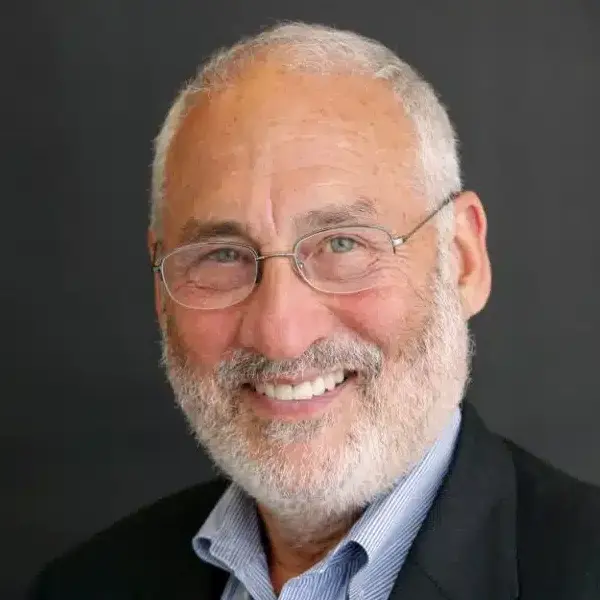
2001 Nobel Laureate in Economics | University Professor, Columbia | Chief Economist, Roosevelt Institute | Former Chief Economist, World Bank

Bestselling Author | Customer Experience & AI Expert | Professor, Vlerick Business School | Co-Founder, Nexxworks


© 2026 Aurum Speakers Bureau. All Rights Reserved

| Basic Data Protection Information | |
|---|---|
| Data controller | AURUM SPEAKERS BUREAU S.L. |
| Address | Parc Audiovisual de Catalunya 1, Oficina S11, 08225 Terrassa, Spain |
| Purposes | We will use your data to respond to your requests and deliver our services to you. |
| Marketing | We will only send you marketing correspondence if you have given your prior consent, which you can do by ticking the box for that purpose. |
| Lawful basis | We will only process your data if you have given your prior consent, which you can do by ticking the box for that purpose. |
| Recipients | Generally, only our members of staff who have been duly authorised may access the data that you have provided. |
| Your Rights | You have the right to know what information we hold about you, to rectify it and to erase it, as explained in the additional information available on our website. |
| Additional Information | For more information, please see “PRIVACY POLICY” on our website. |